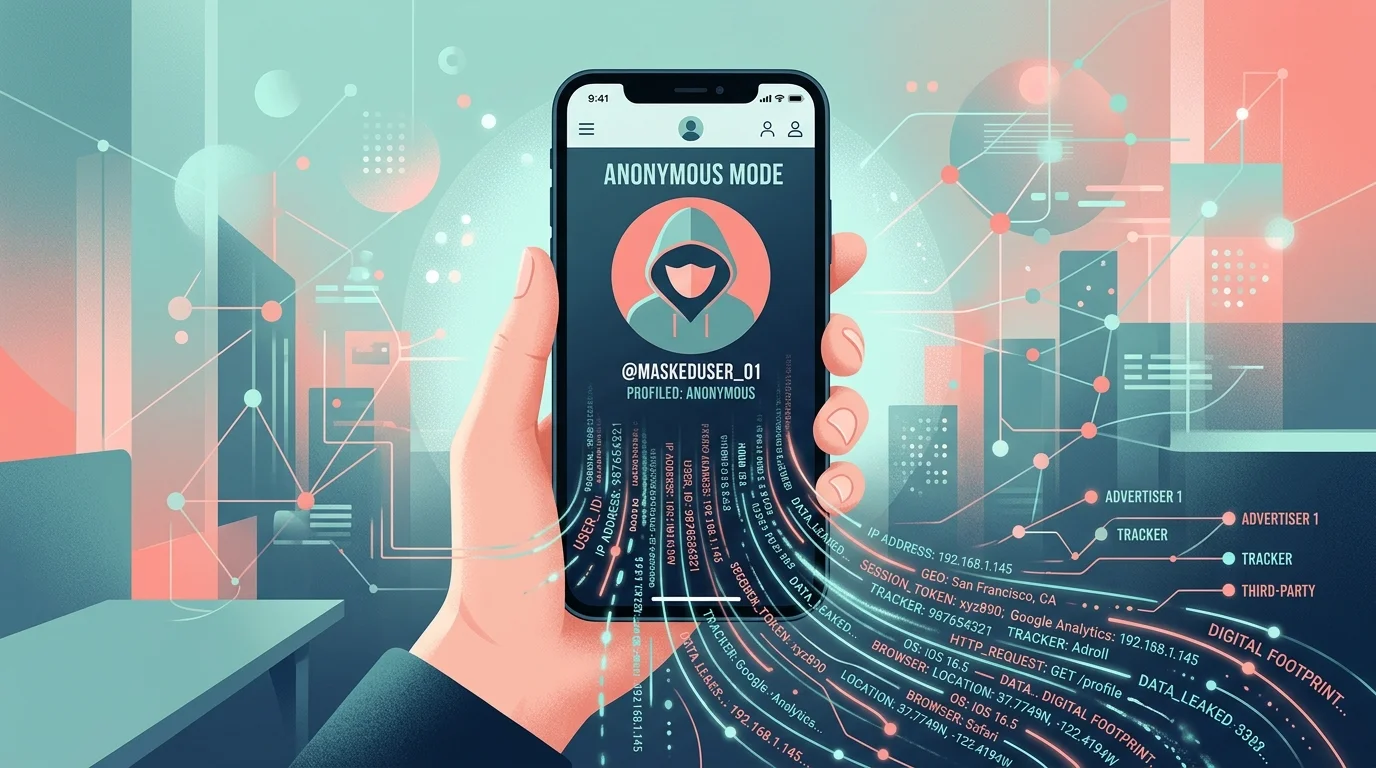
In the wake of shifting reproductive legislation, privacy has become the number one priority for millions of people tracking their menstrual cycles. In response to these concerns, several major femtech companies introduced an “Anonymous Mode”.
Promoted as a quick fix for data tracking fears, these modes promise to let you log your period without linking it to your name or email. But does it actually protect you?
The short answer is no. While it is a step in the right direction, pseudonymity is not the same as true anonymity. Under the hood, your most intimate health details are still vulnerable.
Key Takeaways
- Pseudonymity vs. Anonymity: “Anonymous Mode” removes your email and name, but it still stores your data on a centralized cloud server under a random account ID.
- The Re-Identification Risk: By combining “anonymous” cycle logs with location data, IP addresses, and device identifiers, third parties can easily trace the data back to you.
- The Subpoena Loophole: Centralized databases are subject to warrants. Because these apps are consumer tools, they are not protected by HIPAA and must legally hand over data if subpoenaed.
- The True Solution: Only on-device local storage and zero-knowledge architecture keep your data safe. If the app developer doesn’t have your data, they can’t lose it, sell it, or be forced to surrender it.
1. What is “Anonymous Mode” in Period Trackers?
When you activate “Anonymous Mode” in a typical cloud-based period app, the system creates a pseudonymized account. It decouples your cycle logs from your email address, name, or social media logins, assigning you a randomized ID instead (e.g., user_897654).
To the average user, this feels like complete privacy. However, the critical flaw lies in where that data is stored: on the company’s external cloud servers.
As long as your data leaves your device and travels across the internet to be stored on a centralized database, it is not truly anonymous. It is merely pseudonymized.
2. The Re-Identification Risk: Why Pseudonyms Aren’t Enough
Data privacy experts have repeatedly demonstrated that “anonymized” or pseudonymized datasets can be re-identified with alarming ease.
Every time your app communicates with a cloud server, it transmits a digital footprint. This metadata includes:
- Your IP Address: Which reveals your approximate physical location and internet service provider.
- Device Identifiers: Unique hardware codes (like IDFA for iOS or AAID for Android) that advertisers and trackers use to build a profile of your phone.
- App Usage Behaviors: The exact times and dates you open the app, log symptoms, or update settings.
Data brokers specialize in aggregating these disparate data points. By cross-referencing your “anonymous” period logs with other public or commercial datasets—like your mobile maps history or online credit card transactions—it takes only a few queries to match user_897654 back to your real-world identity.
3. The Subpoena Catch: How Warrants Bypass Pseudonyms
In states with strict abortion bans, the primary concern is whether reproductive health data can be weaponized in legal proceedings.
Many users believe that consumer health apps fall under HIPAA (Health Insurance Portability and Accountability Act) protections. They do not. Period trackers are consumer software products, meaning they are bound by their commercial privacy policies, not federal medical confidentiality laws.
If a law enforcement agency serves a period tracking company with a subpoena or search warrant, the company is legally obligated to comply. Even if the data is stored under a randomized username:
- The warrant can demand the data associated with
user_897654. - The company can be forced to hand over server logs linking that randomized ID to your specific IP address or device identifier.
- Once investigators have the device ID or IP, they can subpoena your mobile carrier or internet provider to get your billing name and address.
True security means having a system with nothing to give up.
4. Zero-Knowledge & Local Storage: The True Solution
The only way to guarantee that your cycle history remains private is to ensure it never leaves your physical control. This is known as Zero-Knowledge Architecture, and it is the foundation upon which Azallea was built.
Rather than trying to hide your identity while uploading your data to the cloud, Azallea keeps your database stored strictly on your device’s local memory.
How Azallea’s Local Storage Protects You:
- No Cloud Databases: Your log history, symptoms, and private notes reside in your phone’s encrypted sandbox. There is no central database for hackers to breach or for authorities to subpoena.
- Decoupled Account Systems: We use Sign in with Apple and Sign in with Google exclusively to verify subscription status. This authentication layer is completely isolated from your health data.
- Support for Masked Emails: For maximum privacy, we support email-masking tools (like Apple’s Hide My Email), allowing you to hide your real identity even from the billing system.
Frequently Asked Questions
Can my period tracker data be subpoenaed?
Yes. If the app stores your cycle logs on its cloud servers, those servers are located in jurisdictions where companies must comply with court orders. Because consumer health apps are not protected by HIPAA, the developer must surrender the logs if served with a valid warrant.
Does “Anonymous Mode” make me untraceable?
No. Anonymous Mode replaces your email/name with a random ID, but the database is still central. Your IP address, device metadata, and network logs are still collected during syncs, allowing data brokers or forensic investigators to re-identify you.
What is the safest way to track my period?
The safest way is to use a tracker that utilizes on-device storage and does not sync your health data to a cloud database. Keeping your cycle history locally on an encrypted device (like with Azallea) ensures your data remains under your physical control.
Take Control of Your Digital Rights
Tracking your cycle is a key part of understanding your body, but it shouldn’t require compromising your human rights. You deserve a tracker that works for you, not for advertisers or data brokers.
By choosing a privacy-by-design tool like Azallea, you are ensuring that your health journey remains exactly what it should be: entirely yours.
Download Azallea today on iOS and Android.


Legal Disclaimer: Azallea is a tracking tool for health insights and is not a form of contraception. The information presented in this article is for educational purposes only and should not be substituted for professional medical advice, diagnosis, or treatment. Always consult with a qualified healthcare provider regarding any medical concerns.