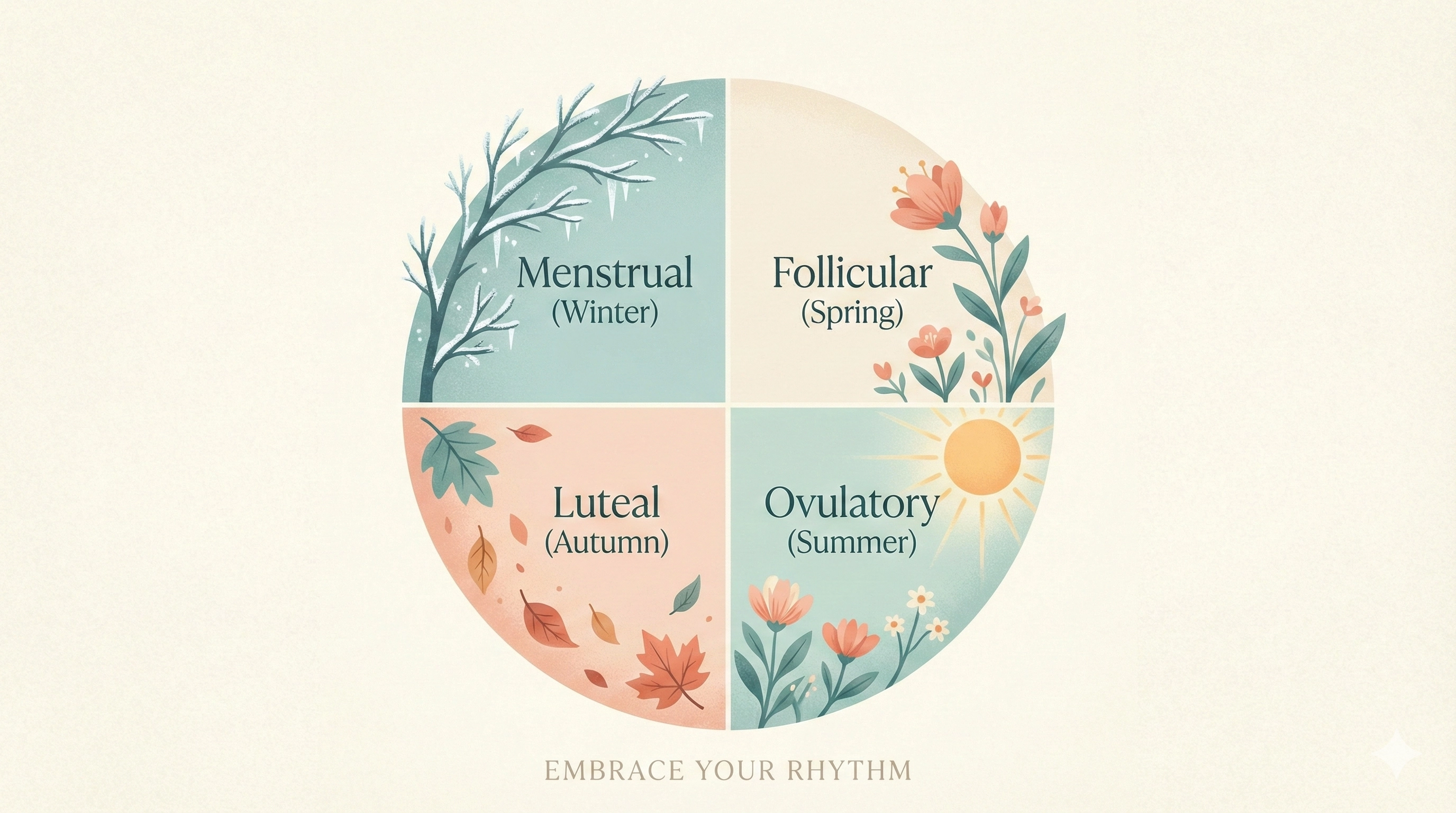
Your menstrual cycle is much more than just “having a period.” It is a sophisticated, month-long biological masterpiece regulated by a delicate dance of hormones. While the average cycle is around 28 days, every woman’s body has its own unique rhythm.
By understanding the four distinct phases of your cycle, you can better predict your energy, moods, and even your physical performance. Best of all, tracking these changes in a private, on-device environment allows you to connect with your body without sacrificing your data security.
Key Takeaways
- The Four Phases: Menstrual, Follicular, Ovulatory, and Luteal.
- Hormonal Drivers: Estrogen (\(E_2\)) and Progesterone (\(P_4\)) are the primary architects of your cycle.
- Biological Preparation: Every cycle is a preparation for a potential pregnancy, even if that isn’t your current goal.
- The Privacy Edge: Your cycle data is some of the most intimate information you own. Understand your body without compromising your digital footprint by using an ad-free, local-storage tracker like Azallea.
1. The Menstrual Phase (The Winter)
Duration: Typically Days 1–5 (can last 3–7 days).
The cycle begins on the first day of your period. If a pregnancy did not occur in the previous cycle, the levels of estrogen and progesterone drop significantly. This drop signals your body to shed the uterine lining (endometrium).
- What’s happening: The “old” lining leaves the body through the cervix and vagina.
- How you feel: You may experience cramping (as the uterus contracts), fatigue, or a desire for rest. This is your body’s time for renewal.
- Pro-tip: Use Azallea’s symptom tracker to log the intensity of your flow and any pain. This data is stored locally on your device, never shared with third parties.
2. The Follicular Phase (The Spring)

Duration: Typically Days 1–13.
This phase actually overlaps with your period but continues until ovulation. Your brain releases Follicle-Stimulating Hormone (FSH), which tells your ovaries to prepare several “follicles”—tiny, fluid-filled sacs that each contain an immature egg.
- What’s happening: One dominant follicle matures while the others are reabsorbed. This follicle pumps out Estrogen (\(E_2\)), which helps thicken the uterine lining again.
- How you feel: As estrogen rises, your energy levels, mood, and cognitive clarity often improve. You might feel more social and motivated.
- Hormonal Note: Estrogen acts like a natural “mood booster” during this phase.
3. The Ovulation Phase (The Summer)
Duration: Roughly 24–48 hours (around Day 14 in a 28-day cycle).
The “main event” of your cycle. A surge in Luteinizing Hormone (LH) causes the dominant follicle to rupture, releasing a mature egg into the fallopian tube.
- What’s happening: This is the only time in your cycle when pregnancy is possible. The egg lives for only 12–24 hours, though sperm can survive for up to 5 days in the reproductive tract.
- How you feel: You may notice a spike in libido, increased “egg-white” cervical mucus, or a slight twinge in the lower abdomen (known as mittelschmerz).
- Tracking Ovulation: Azallea provides discrete reminders and fertility windows based on your logged data, helping you understand your peak days in an ad-free environment.
4. The Luteal Phase (The Autumn)
Duration: Typically Days 15–28.
After the egg is released, the empty follicle transforms into a structure called the corpus luteum. This structure produces Progesterone (\(P_4\)), the hormone of “maintenance”.
- What’s happening: Progesterone keeps the uterine lining thick and spongy, ready for an embryo to implant. It also causes your Basal Body Temperature (BBT) to rise slightly by \(0.3^\circ C\) to \(0.5^\circ C\).
- How you feel: If pregnancy doesn’t occur, the corpus luteum withers, progesterone drops, and the drop can trigger PMS symptoms like bloating, breast tenderness, or irritability.
- The Transition: This drop in hormones is what eventually triggers the start of a new Menstrual Phase.

What Influences Your Cycle Rhythm?
No two cycles are identical, and several factors can cause your phases to shift:
- Life Stages: From menarche (first period) to menopause, your cycle evolves.
- Stress: High cortisol can delay ovulation or even skip a cycle entirely.
- Lifestyle: Diet and excessive physical activity play significant roles in hormonal production.
- Medical Conditions: Conditions like PCOS, Endometriosis, or thyroid imbalances can lead to irregular phases.
When Should You See a Specialist?
The menstrual cycle is a “fifth vital sign”—it tells you a lot about your overall health. You should consult a gynecologist if you experience:
- Periods that consistently last longer than 7 days.
- Cycles shorter than 21 days or longer than 35 days.
- Severe, debilitating pain that prevents daily activity.
- Sudden changes in your bleeding patterns.
Secure Your Cycle Intelligence with Azallea

Understanding your phases is the first step toward hormonal health. But in an age where health data is often commodified, where you track that information matters.
Azallea is a private, on-device tracker designed for women, by a woman. We believe your intimate health data belongs to you alone.
- Privacy-First: We use Google Sign-in and Sign in with Apple only for subscription management; your health logs are stored locally on your device.
- Ad-Free: No targeted ads based on your fertility status or symptoms.
- Evidence-Based: Track your temperature shifts, moods, and energy levels to find your unique patterns.
Understand your body without compromising your digital footprint.
Download Azallea today on iOS and Android.


Legal Disclaimer: Azallea is a tracking tool for health insights and is not a form of contraception. The information presented in this article is for educational purposes only and should not be substituted for professional medical advice, diagnosis, or treatment. Always consult with a qualified healthcare provider regarding any medical concerns.