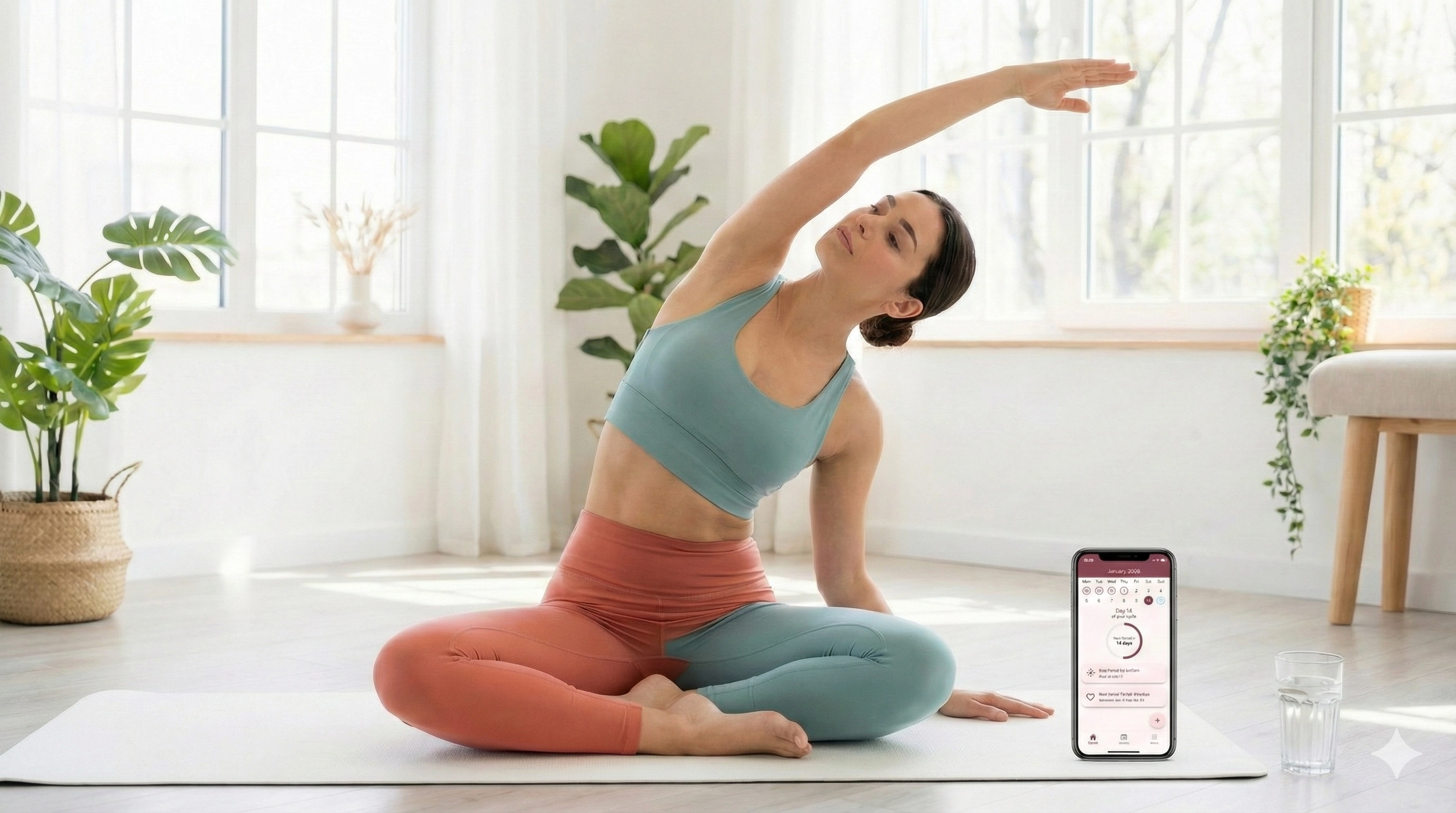
Have you ever noticed that some days you feel like an elite athlete, and other days simply walking to the gym feels like a marathon? This isn’t a lack of discipline—it’s biology.
Your energy levels, muscle recovery, and even your risk of injury fluctuate alongside your hormones. By practicing “cycle syncing"—aligning your movement with your four menstrual phases—you can work with your body instead of against it.
Key Takeaways
- Hormonal Impact: Estrogen generally boosts energy and strength, while Progesterone can increase heart rate and body temperature.
- Phase-Based Fitness: High-intensity training is best suited for the Follicular and Ovulatory phases.
- Recovery is Productive: The Menstrual and Luteal phases require more restorative movement to manage inflammation and fatigue.
- Privacy in Fitness: Logging your performance trends alongside your cycle helps you find your “power days.” Using a private, on-device tracker like Azallea ensures your intimate health data stays secure and ad-free.
Why Your Cycle Affects Your Workout

The menstrual cycle is driven by the rise and fall of two main hormones: Estrogen (\(E_2\)) and Progesterone (\(P_4\)).
- Energy & Power: High estrogen (Follicular phase) is associated with higher energy and better insulin sensitivity, making it the ideal time for building muscle.
- Metabolism & Heat: High progesterone (Luteal phase) slightly raises your basal body temperature by \(0.3^\circ C\) to \(0.5^\circ C\) and increases your resting heart rate, which can make cardio feel more “breathless” than usual.
- Pain Sensitivity: Research suggests that pain tolerance may be lower during the late luteal and early menstrual phases, meaning you might feel “the burn” more intensely.
Cycle Syncing Your Workouts: Phase by Phase

1. The Menstrual Phase (Days 1–5)
The Vibe: Low energy, potential cramping, and low hormone levels.
Best Exercises: Walking, gentle Yin yoga, swimming, or light stretching.
Focus: Movement that encourages blood flow to the pelvic area to relieve tension.
Listen to Your Body: If your pain is severe, rest is the most productive “workout” you can do.
2. The Follicular Phase (Days 6–13)
The Vibe: Rising estrogen leads to a “rebound” in energy and mental clarity.
Best Exercises: High-Intensity Interval Training (HIIT), heavy strength training, and new, challenging cardio routines.
Focus: This is your time to set a Personal Best (PB). Your muscles are primed for growth and recovery.
3. The Ovulation Phase (Day 14)
The Vibe: Estrogen and testosterone peak. You are likely at your strongest and most social.
Best Exercises: Group fitness classes, powerlifting, or vigorous outdoor runs.
Focus: Maximize your peak strength. Note: Some studies suggest a slight increase in ligament laxity during ovulation, so ensure proper form to protect your joints.
4. The Luteal Phase (Days 15–28)
The Vibe: Progesterone takes the lead. You may feel “heavier,” more irritable, or warmer.
Best Exercises: Pilates, slow-strength training, hiking, or moderate aerobics.
Focus: Since your body is working harder to stay cool, lower the intensity. Prioritize hydration and rhythmic breathing to reduce stress levels.
People Also Ask (FAQ)
Is it safe to exercise during my period? Absolutely. In fact, exercise releases endorphins which act as natural painkillers. However, avoid “forcing” a high-intensity session if you are feeling fatigued or experiencing heavy flow.
Why do I feel weaker the week before my period? During the Luteal phase, your body is preparing for a potential pregnancy, which uses more resting energy. Your heart rate is higher, and your body is less efficient at using carbohydrates for fuel, making intense exercise feel significantly harder.
Can I track my fitness gains in my period app? Yes! In Azallea’s premium version, you can log symptoms, energy levels, and sexual activity. Seeing these trends over 3-4 months helps you predict when you’ll have the most energy.
5 Essential Tips for Your Journey
- Consult Your Doctor: Before starting a new program, especially if you have conditions like Endometriosis or PCOS.
- Listen to Your Body: A tracking app is a guide, but your internal “bio-feedback” is the ultimate authority.
- Vary Your Routine: Cross-training prevents boredom and ensures all muscle groups are supported across different phases.
- Breathwork: Practice deep, diaphragmatic breathing to manage cortisol levels, especially during the Luteal phase.
- Recovery: Incorporate warm baths and meditation to reduce muscle tension and PMS-related stress.
Understand Your Body Without Compromising Your Digital Footprint

Your fitness journey is personal, and so is your data. Most cycle trackers sell your energy trends and mood data to advertisers.
Azallea is built differently. As a private, on-device tracker, we ensure that your data never leaves your phone. You can track your symptoms, mood, and sexual activity in a completely ad-free environment designed for women, by a woman.
Train smarter, not harder.
Download Azallea today on iOS and Android.


Legal Disclaimer: Azallea is a tracking tool for health insights and is not a form of contraception. The information presented in this article is for educational purposes only and should not be substituted for professional medical advice, diagnosis, or treatment. Always consult with a qualified healthcare provider regarding any medical concerns.